
American Canyon City Directory Collections
Verified local material is a collection of related sources, not a confirmed standalone American Canyon city directory run. The table separates a true directory lead from a historical index or companion record. Coverage refers to the series described in the research record. It does not prove that every American Canyon household appears in every volume.
| Collection | Years and publisher | Where held | Access and use |
|---|---|---|---|
| Polk City Directories for Napa | 1937, nearly continuous through the 1950s; R.L. Polk | California State Library; related digitized leads | Alphabetical resident and business trail; test Napa Junction |
| Great Registers | 1880-1894 and 1908-1956 | Napa Valley Genealogical Society | Historical voter names, residence, age or occupation as series permits |
| Tax assessments | 1884-1893 | Napa Valley Genealogical Society | Owner, property, and value leads |
| Obituary files | 1970-2003 and 2011-2014 | Napa Valley Genealogical Society | Family, residence, funeral, and cemetery leads |
| Cemetery index | 1850-2013 | Napa Valley Genealogical Society | Burial dates and family linkage |
| Napa Register | Weekly, 1864-1921 | California Newspaper Microfilm Archive and Library of Congress directory | Notices, social items, deaths, and legal advertising |
The Open Napa County gateway is useful for current official records, but it is not a historical city directory shelf. A catalog citation, a scanned title page, and an inspected household entry are three different levels of proof.
The Open Napa County records gateway shows how a historical directory lead eventually meets a custodian-held record.
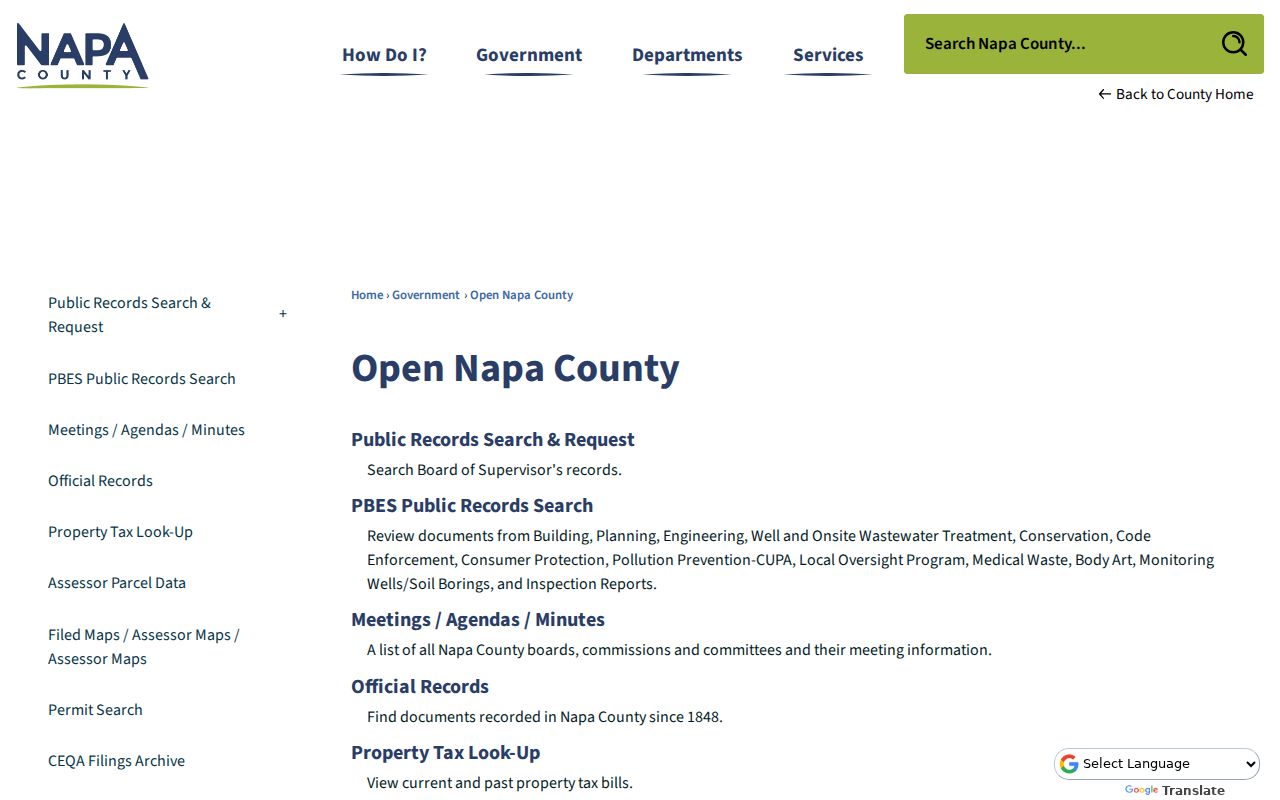
Use the gateway for the current deed, map, permit, or clerk record that can anchor an older directory name.
American Canyon's Napa Junction Directory Search
American Canyon incorporated on June 1, 1992. A printed volume from before that date may describe the community as Napa Junction, southern Napa County, a countywide area, or a Vallejo-area place. “American Canyon” is therefore only one search term. Put Napa Junction beside the surname, street, business, newspaper, and map query.
The older name is practical, not decorative. A 2024 library program, “From Raids to Railroads,” documented Napa Junction's Prohibition-era roadhouses, speakeasies, raids, and railroad history. Those subjects can produce a person, business, property, or newspaper trail even when a modern city query returns nothing. Record the wording used by the catalog and do not normalize it away.
For a pre-incorporation address, search the countywide and City of Napa scope first, then use APN, legal description, cross streets, or a recorded deed to decide whether the historical item connects to present-day American Canyon.
American Canyon Polk City Directories
The California State Library collection documents R.L. Polk City Directories for the City of Napa beginning in 1937 and running nearly continuously through the 1950s. That is a strong historical shelf, but it is not evidence of a dedicated American Canyon edition or universal coverage of southern Napa County. A good city directory search checks the title page and geographic statement before using an entry.
Search the digitized R.L. Polk results for Napa-related volumes, then ask the California State Library to confirm the exact title, publication year, and call number. A scan or catalog record can establish publisher and year. It cannot establish that a particular Napa Junction household appears unless the page is inspected.
Use spelling variants, initials, alternate surname forms, and the old place label. Keep the volume's claimed coverage beside every transcription. A person absent from one year may have moved, died, changed a name, fallen outside the volume's boundary, or simply been missed by a private publication.
Note: A catalog year is evidence of a publication, not proof that an American Canyon household is included.
American Canyon Directory Gaps and Registers
When a Polk volume does not reach the needed year or place, Napa Valley Genealogical Society's Great Registers provide a different historical presence clue. The verified series covers 1880 to 1894 and 1908 to 1956. Depending on the series, entries can support a name, age, occupation, and residence lead. They are historical election records, not modern browseable voter files.
NVGS also holds Napa County marriage abstracts from 1850 to 1905 and an index from 1850 to 1975, birth abstracts from 1873 to 1905 with a member index from 1866 to 1916, death abstracts from 1873 to 1905, tax assessments from 1884 to 1893, obituary files, cemetery indexes, and more than 9,000 holdings. Each series has its own coverage and lookup method.
Search by title, author, subject, location, or call number in the Society's LibraryWorld catalog. A result may point to an original book and page at the Napa County Records Office. Treat the index citation as a lead, then obtain the underlying record when the question requires proof.
Reading an American Canyon City Directory Entry
An authoritative digitized Napa Junction or American Canyon entry was not accessible for inspection. A careful city directory page should say that plainly. Do not claim that a local entry contains a spouse, occupation, owner or renter mark unless the actual volume and page have been examined. The physical Polk volume may contain those fields, but the research record does not verify a particular local entry.
During an inspection, transcribe the entry exactly and capture the title page, geographic scope, abbreviation key, alphabetical section, business section, and any street or householder section. Then note the fields that are visibly present:
| Surname and given name | Copy initials, spelling, punctuation, and any variant exactly as printed. |
|---|---|
| Address section | Check whether the volume has a street or reverse listing and how it labels the address. |
| Occupation or employer | Record only what the entry states and use its own abbreviation key. |
| Household notation | Do not infer spouse, widow, ownership, or occupancy from a symbol until the volume explains it. |
| Publication context | Keep publisher, year, title, place scope, and page number with the transcription. |
- Criss-cross directory
- A reverse directory arranged by street or address when the volume includes that section.
- Householder index
- An address or head-of-household list whose coverage and definition must be read from the volume.
- Abbreviation key
- The publisher's explanation of short forms, marks, and move or residence notes.
- Index versus image
- A catalog or name pointer is not the scanned or physical page containing the entry.
The distinction matters in an American Canyon city directory search because a historical omission can reflect place naming, coverage, a move, death, or editorial choice. It should not be turned into a claim that no one lived there.
American Canyon Genealogy Directory Desk
The Napa Valley Genealogical Society is at 1701 Menlo Avenue, Napa, 707-252-2252. It is staffed Wednesday and Thursday from 10 to 1, the first Tuesday from 10 to 1, and the first Saturday from noon to 3, with 48-hour appointment requests. The collection has more than 9,000 holdings, more than 100 microfilm or fiche rolls, ScanPro scanners, and FamilySearch affiliate access.
On-site databases include Newspapers.com, Fold3, AniMap, and American Ancestors. Most holdings do not circulate. A suggested nonmember donation is $10 per visit. Named lookups can be requested at Librarian@NapaGenSoc.org with the target name, date, and “Look-up Request” in the subject. Mailed paper copies cost $3 prepaid, excluding marriage-index copies. Deeper research is $30 for the first hour and $15 for each additional hour, prepaid and nonrefundable.
Use the branch at American Canyon Library for catalog help and routing. The branch at 300 Crawford Way, 707-644-1136, has occupied its current central site since August 2012. Ask about local newspapers, yearbooks, vertical files, telephone books, Polk material, microfilm, and genealogy databases. A catalog miss is not proof that a shelf item does not exist.
American Canyon Historical Directory Photos
Napa County Historical Society, at 1219 First Street in Napa, uses a CatalogIt catalog and research library. Exact phrases, plus signs between search terms, alternate spellings, “Napa Junction,” and street names without house numbers are practical search tactics. The Society warns that photographs may use historic or common place names rather than modern addresses.
The Napa Recorder-County Clerk services page is the local custodian route for a current deed or recorded map that can anchor a historical name.
In-person appointments are free. Remote property, genealogy, and general research is listed at $50 per hour prepaid, or $20 per hour for nonprofits, with normal delivery in about four weeks and a possible 25 percent rush surcharge. This is a different access model from a self-service city directory scan.
The Society's Luther Turton Architectural Drawings span 1889 to 1921, with the bulk from 1905 to 1919 and 305 drawing sets. They cover residences, businesses, schools, churches, and industrial buildings. A deed or directory surname can be the bridge to a client or business index, but the drawings should not be described as a verified American Canyon address collection until the finding aid supports it.
The Society's Online Archive of California finding aids help identify collection scope before requesting a remote search.
The Napa Recorder-County Clerk page is the source for the current-record handoff shown here.
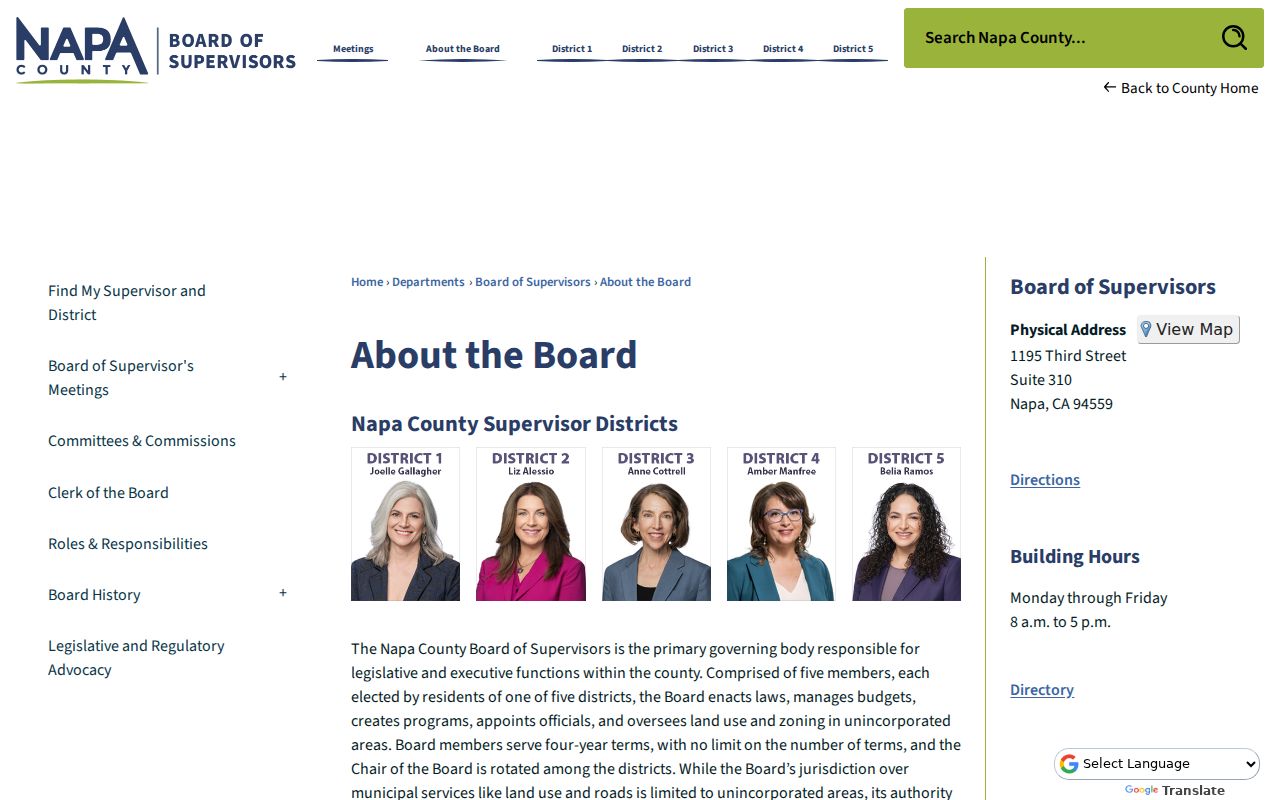
Current county records can anchor the surname that opens a historical collection, but the two record layers should not be conflated.
The Napa Elections office is another dated public-record custodian when a historical register or current election question needs confirmation.
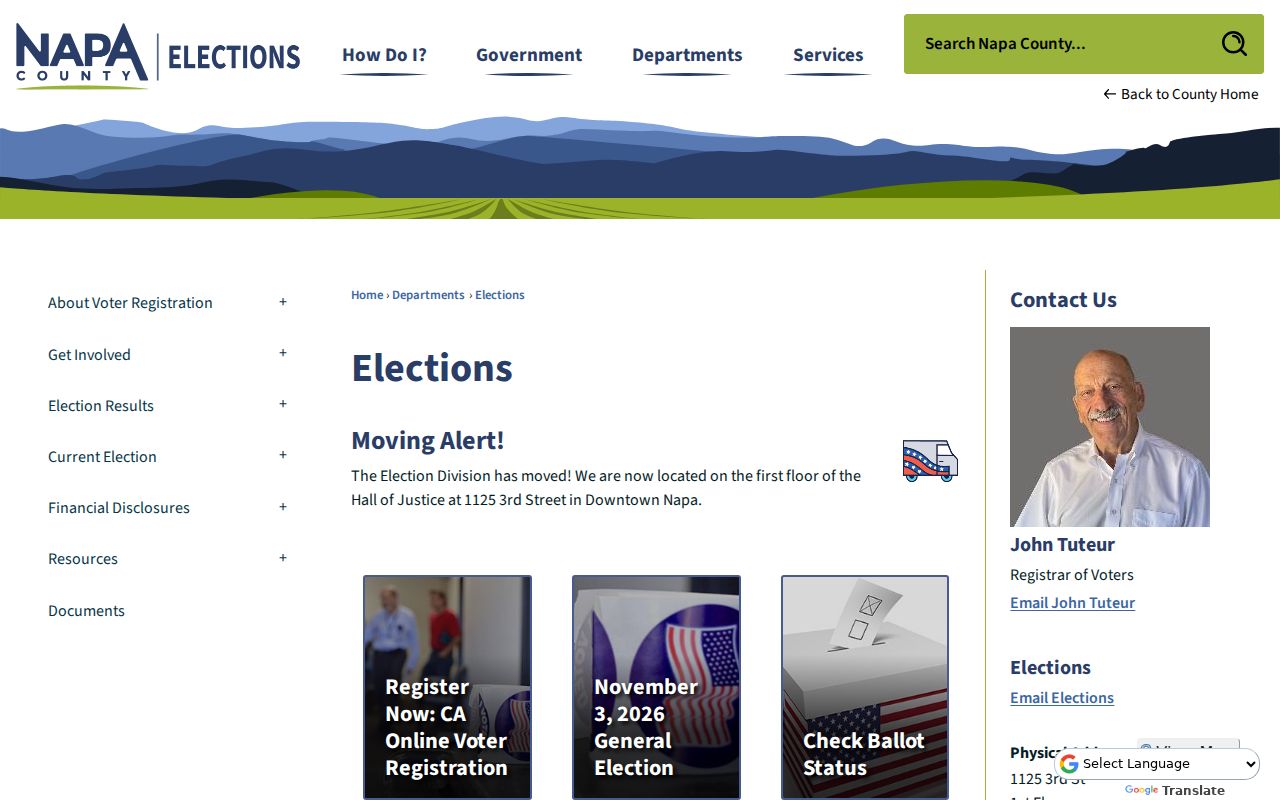
An election office record has its own eligibility and privacy rules, separate from a historical directory shelf.
American Canyon Map Records and Limits
Sanborn fire maps are useful for building footprints and use, but the verified Napa series does not establish an American Canyon map set. Napa city sheets are documented for 1891, 1901, 1910, 1924, and 1941 on California State Library microfilm. The Library of Congress has a 1910 Napa set of 35 sheets. No authoritative American Canyon or Napa Junction Sanborn sheet was located.
Search the Library of Congress Sanborn collection and state-library finding aids, then read the map title and geographic scope. A Napa-city building footprint cannot be silently moved across the county line. For an American Canyon property, deeds, filed maps, permits, photographs, and historical society records may be better-supported paths.
That boundary is an example of good directory practice: a nearby collection can be a clue without becoming a claim about the target place.
American Canyon Directory Family Trail
A historical American Canyon city directory becomes useful when each entry is paired with another dated source. Start with a name and place variant. Preserve the exact address, occupation, spouse notation, and publisher wording. Then test whether the same household remains at the address or whether the apparent gap is a change in place label or coverage.
- Set the target era and search both American Canyon and Napa Junction, plus countywide or City of Napa volumes.
- Ask the California State Library to confirm the Polk title, year, call number, and geographic scope before relying on a catalog entry.
- Inspect the volume's abbreviation key, alphabetical section, business section, and reverse or street section if present.
- Transcribe consecutive years, preserving variants, spouse marks, occupational abbreviations, and move notes as the volume defines them.
- Pair the result with Great Registers, tax assessments, deeds, census schedules, newspapers, probate, cemetery, and obituary records.
Federal population schedules are public through 1950 under the 72-year rule. A directory is a private publication that can lag a move, so a census date and a deed date should be treated as separate evidence. If a household disappears, check death, probate, a changed address, a changed community label, and the next volume's coverage before concluding that it left.
For a modern address handoff, the American Canyon street directory covers parcel and current address records, while a one-person match belongs with the resident lookup workflow.
Historical caution. A directory is evidence of a publisher's entry on a publication date, not a complete census of every person living in American Canyon.